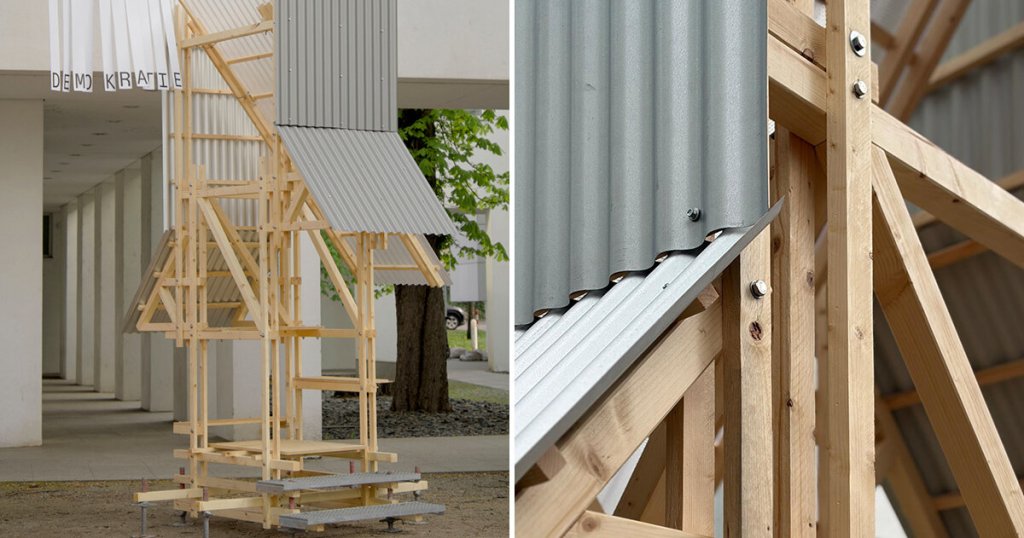
When I see work like this, my first thought is always: how did they make it, and why does that method matter? A recent project from architecture students at Frankfurt University of Applied Sciences answers both questions in a pretty direct way. Their mobile voting booth, installed outside the Museum of Applied Arts in Frankfurt as part of World Design Capital 2026, is not trying to symbolize democracy with a slick graphic or a slogan wall. It is doing something smarter. It turns participation into structure.
The booth is built from a lightweight timber frame assembled from standardized parts, with bolted joints left visible and legible. That detail matters. For those of us who spend time in shops and studios, visible joinery is never just a technical choice. It tells you whether a project wants to be understood, repaired, adapted, and remade. Here, the construction logic is part of the argument. This is a civic object you can read.
According to the project description, the students paired that timber skeleton with corrugated metal panels and translucent plastic skins. So you get alternating conditions of openness and enclosure, exposure and shelter, light and opacity. That is not just formal play. It creates a sequence of thresholds that mirrors the emotional reality of public participation. Stepping forward, taking a position, being seen, hesitating, re-entering—those are all part of civic life, and the booth gives them physical form.
What I appreciate here is the refusal to separate concept from fabrication. Too often, design discourse treats making as the final service layer, as if the idea arrives first and the build merely follows. This project works because the material system is the concept. Standardized timber members, bolted connections, reusable parts, and transportable assembly all reinforce the idea that democratic space should be accessible, repeatable, and open to revision. That is good maker thinking.
It also fits the larger ambition of World Design Capital Frankfurt RheinMain 2026, which has framed the year around “Design for Democracy” and a broader program of participatory projects across the region. That context matters because it moves this booth beyond student exercise territory. It becomes a prototype for how temporary architecture can activate public space without needing a massive budget or a permanent footprint.
And from a fabrication perspective, this is exactly the kind of project the craft community should be paying attention to. Small-scale civic structures are one of the clearest places where design-build education, digital modeling, and practical assembly knowledge can genuinely meet. You can imagine a version of this emerging from a community woodshop, a university fabrication lab, or a public design/build program. The ingredients are familiar: standard stock, straightforward fasteners, panel skins, and a layout that rewards careful sequencing more than extravagant means.
There is also a quiet lesson here about finish. Because the joints are exposed and the materials are relatively ordinary, the project depends on proportion, detailing, and restraint rather than luxury. That is a useful reminder for makers working between art, architecture, and installation. You do not need expensive material to create significance. You need a clear reason for every piece, every edge, every change in light.
The strongest design work often gives people a role, not just a view. This booth does that. It asks visitors to move, choose, climb, pause, and position themselves within a shared structure. That is a more generous understanding of design than the image-first work we usually see circulate online.
I would love to see more projects like this in American cities—not as branding exercises, but as real civic prototypes made with local materials and local hands. If democracy is something we practice, then maybe our public structures should feel practiced too: assembled, adjusted, occupied, and understood.
 Artisanal Metals
Leave a comment