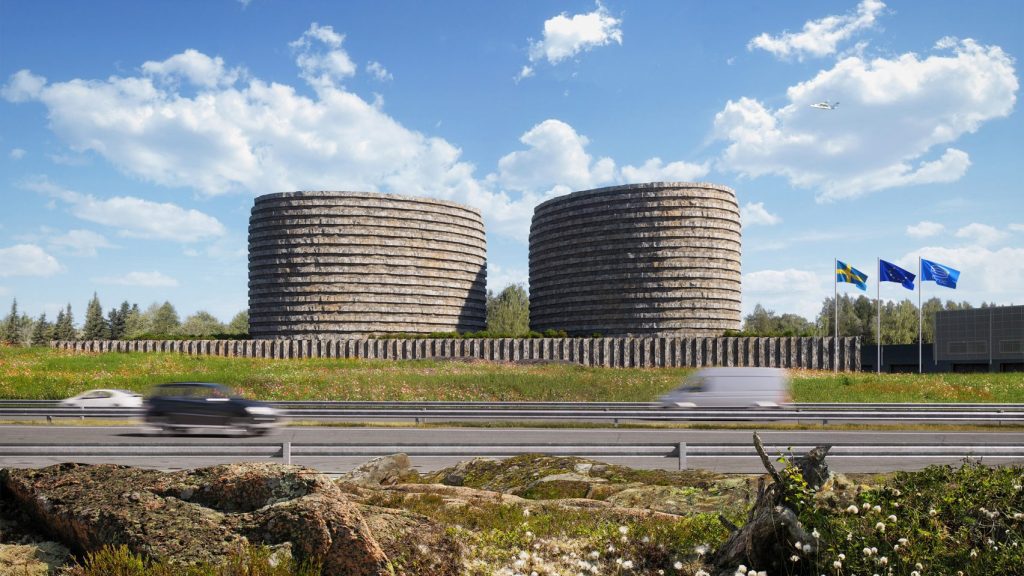
Stone Clouds: What Happens When We Build Data Centers Like Cathedrals
Here’s something I didn’t expect to be writing about today: a data center made from structural granite
When I first saw this, my maker brain lit up. We’re so conditioned to think of stone as decorative — a veneer you slap on a steel frame to make it look expensive. But stone has incredible compressive strength. It’s been holding up buildings for millennia. The question is: why did we stop using it structurally?
The engineering reality
Working with Webb Yates Engineers, the team developed a system of standardized granite panels that function as the primary structure. The design uses two oval-shaped towers sitting on a triangular base — the curves aren’t just aesthetic. They’re working with the material’s strengths, distributing loads the way stone wants to carry them.
What strikes me is the thermal strategy. Massive stone walls create what engineers call “thermal inertia” — they stabilize interior temperatures across seasons without requiring as much active cooling. For a data center, where cooling is one of the biggest energy costs, that’s not poetry. That’s performance.
The fabrication question
Here’s where I start thinking about what this actually means to build. Standardized granite panels at this scale require serious quarrying and cutting infrastructure. You need precision — these aren’t rough-hewn blocks. They’re engineered components that have to fit together with structural tolerances. Sweden has the granite. They have the quarrying tradition. But scaling this to a building of this size? That’s a supply chain and fabrication challenge that most contractors have never faced. The skills exist, but they’re scattered — in restoration work, in monument carving, in high-end architectural stone. Bringing them together for a project like this is part of what makes it interesting.
Why this matters beyond the building
Svenstedt said something that stuck with me: “Like the beloved industrial buildings of the past, the data centers are made to one day become offices, housing, or even cultural destinations like museums.” That’s a long-term view we rarely see in tech infrastructure. Most data centers are built to be obsolete — metal boxes designed for a 15-year lifespan, then demolished. This is designed to outlast its original purpose. The stone doesn’t care what’s inside it. The craft community should be paying attention
We talk a lot about traditional materials making a comeback — timber frame construction, rammed earth, natural plasters. Structural stone is the next frontier, and it’s going to need people who understand how to work it.
If you’re a stone carver, a mason, or someone who’s been keeping those skills alive in restoration work, projects like this might be your future. The scale is different, but the material knowledge is the same. What traditional material do you think deserves a second look for structural applications?See the Dezeen article at the following link
https://www.dezeen.com/2026/02/26/stone-clouds-data-centre-carl-fredrik-svenstedt-architects/
Carl Fredrik Svenstedt Architects has unveiled plans for the Stone Clouds data centre in Sweden, which will be built from structural stone.


 Artisanal Metals
Leave a comment